
Imagine walking into a shop in January to buy a graphics card, deciding to wait for a better deal, and walking back in November to find the same card costs half as much again. For a lot of PC builders, that was 2026.
At the end of 2025, things looked fine. Most RTX 50 and Radeon RX 9000 cards were selling near their launch prices. Then memory chips got scarce, and graphics card prices took the elevator up. This page pulls together the price tracking done by TechSpot, PC Gamer, Tom’s Hardware and others, so you can see what happened to each card and when.
One note before the numbers. Every figure here is the lowest price a tracker found at the time, usually in the US. Sometimes that’s a third-party seller rather than a big shop. Treat them as snapshots, not promises.
Why prices went up
The short version is memory. Graphics cards use special fast memory called GDDR6 and GDDR7, and the same factories that make it also make memory for AI servers. AI companies are buying enormous amounts, so there’s less to go around for everyone else.
The warning signs showed up in December 2025, when Outlook India’s Respawn reported claims that NVIDIA could cut RTX 50 supply by 30 to 40 percent because of the GDDR7 shortage, and that AMD had told partners to expect price rises of at least 10 percent. These were reports rather than confirmed plans, but the direction turned out to be right.
In January 2026, PCGamesN reported, citing Benchlife, that NVIDIA had told its partners the memory it bundles with its graphics chips was getting more expensive. ASUS emailed partners about its own price rises, blaming "AI-driven price volatility in DRAM, NAND, and SSD components", according to TechSpot. In August, The Next Web reported a second round of increases from ASUS and Gigabyte covering both RTX 50 and RX 9000 cards.
The quick timeline
From November 2025 to February 2026, global graphics card prices rose about 15 percent across ten countries, according to TechSpot data reported by Wccftech. The top cards jumped first. In the US, the cheapest RTX 5090 went up 40 percent and the RTX 5080 went up 43 percent, while the RTX 5060 barely moved.
From roughly March to July, prices were "relatively stable", as PC Gamer put it. Stable, but high.
Then the midrange cards took a hit over the summer. PCGamesN, citing Tom’s Hardware and Newegg data, found the median RTX 5060 Ti 16GB price went from $569.99 in June to $804.99 in August, and the RTX 5070 went from $659.99 to $899.99.
By November, almost every card was at its most expensive point of the year. The RTX 5070 Ti’s cheapest US price jumped from $1,179.99 to $1,339.99 in just eight days, from October 29 to November 6, Notebookcheck reported.
Card by card
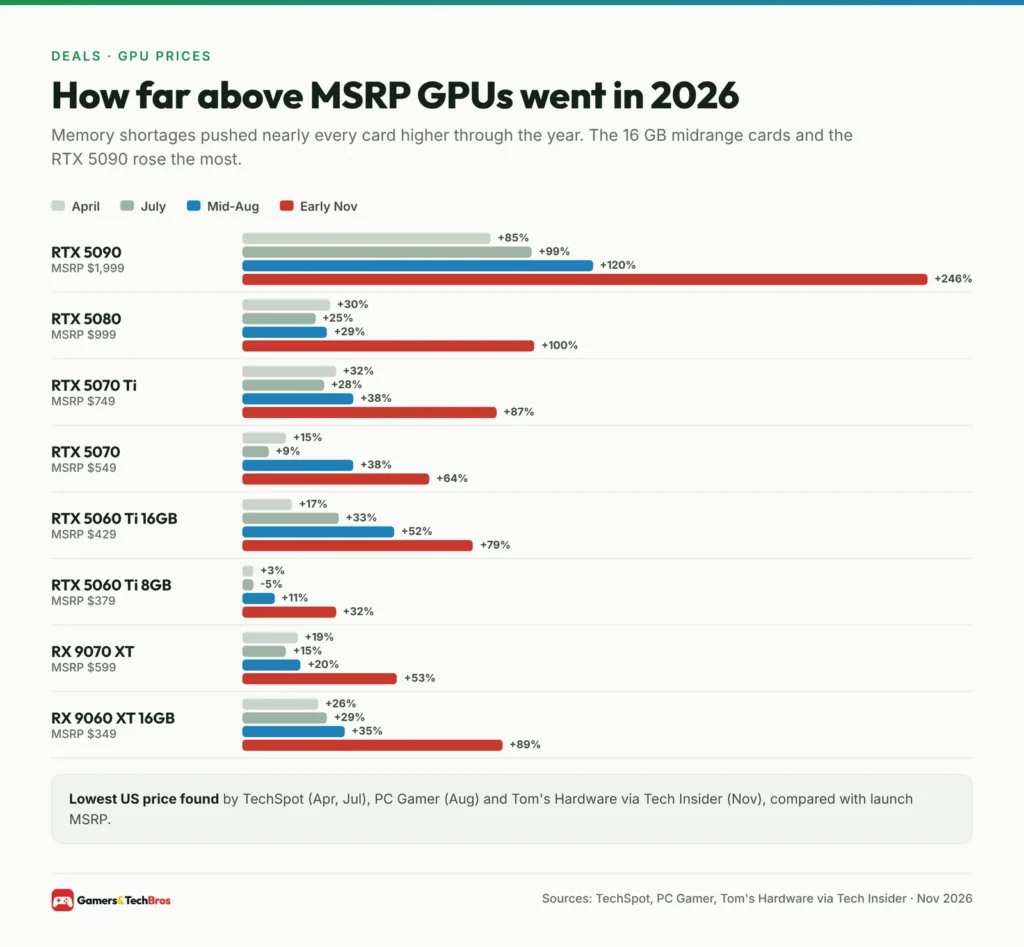
Here’s the cheapest US price at four points in the year, next to each card’s launch price (MSRP). April is from TechSpot’s Q2 report, July from TechSpot’s mid-2026 report, mid-August from PC Gamer’s weekly tracker and early November from Tom’s Hardware’s tracker as reported by Tech Insider.
| Card | MSRP | April | July | Mid-August | Early November |
|---|---|---|---|---|---|
| RTX 5090 | $1,999 | $3,700 | $3,980 | $4,400 | $6,919 |
| RTX 5080 | $999 | $1,300 | $1,250 | $1,290 | $1,999 |
| RTX 5070 Ti | $749 | $990 | $960 | $1,030 | $1,399 |
| RTX 5070 | $549 | $630 | $600 | $755 | $899 |
| RTX 5060 Ti 16GB | $429 | $500 | $570 | $650 | $769 |
| RTX 5060 Ti 8GB | $379 | $390 | $360 | $420 | $499 |
| RX 9070 XT | $599 | $710 | $690 | $720 | $919 |
| RX 9070 | $549 | $610 | $620 | $650 | not reported |
| RX 9060 XT 16GB | $349 | $440 | $450 | $470 | $659 |
The MSRPs are the US launch prices given in these reports. Different trackers check different stores, so a small dip between two columns might just be a different tracker, not a real price cut.
What stands out
The 8GB cards held up best. In July, TechSpot found the cheapest RTX 5060 Ti 8GB selling below its MSRP, and the RTX 5060 was roughly at its launch price. Cards with less memory need fewer of the scarce chips, so they felt less of the squeeze. Even so, the 5060 Ti 8GB was about a third over MSRP by November.
The 16GB midrange cards had a rough second half. The RTX 5060 Ti 16GB and RX 9060 XT 16GB both ended up nearly 80 to 90 percent above their launch prices. These were the go-to cards for people who wanted plenty of video memory without spending a fortune, which makes this one sting.
The RTX 5090 went somewhere else entirely. It was already about double its MSRP by spring and finished the period around three and a half times its launch price. Tech Insider’s readings suggest it stopped climbing between late September and early November, sitting just under $7,000. "Stopped climbing" is doing a lot of work in that sentence.
AMD’s cards rose more slowly in percentage terms for most of the year. In November the RX 9070 XT was about 53 percent over MSRP, compared with about 64 percent for the RTX 5070 and 79 to 87 percent for the RTX 5070 Ti.
Black Friday didn’t fix much. On November 28, PC Gamer’s deals page listed the cheapest RTX 5070 at $900, the RTX 5060 Ti 16GB at $760 and the RX 9070 XT at $980.
Will prices come down?
Nobody can promise that. TechSpot said in July that prices were "unlikely to decrease anytime soon", and PC Gamer reported in late July that the memory shortage isn’t expected to end until at least 2029. On the other hand, TechSpot also noted that slow sales could hold prices steady for a while, because shops can’t charge more than people will pay forever.
If you need a card now, the 8GB models and cards like the RX 9070 XT have stayed closest to their launch prices. If you can wait, keep an eye on price history for the exact card you want, using the tricks in our Black Friday deal-checking guide. And if your current card still runs your games, giving it one more year might be the most money-saving move of all.
Keep reading
How we researched this guide: the prices come from TechSpot’s Q2 and mid-2026 GPU pricing reports, PC Gamer’s weekly price tracker (August 2026) and its Black Friday 2026 deals page, Tom’s Hardware’s tracker as reported by Tech Insider (November 2026), and news reports from Notebookcheck, PCGamesN, Wccftech, The Next Web, TechSpot and Outlook India’s Respawn, all checked on November 28, 2026. Percentages are our own math against the US launch price. We did not track prices ourselves.