
A big red banner says 57 percent off. The old price has a line through it. A little timer is counting down. Your brain says "buy it now", and your wallet starts sweating.
Here’s the trouble. That crossed-out number is often not a price anyone actually paid. PCWorld found an Amazon listing for a WD M.2 SSD with a "list price" of $1,379 and a "save $1,030" badge. Price trackers showed the highest price Amazon had ever charged for that drive was about $739. The "deal" was real in the sense that the drive was cheaper than a number on a screen. That’s about it.
So before you click, spend two minutes checking. This guide shows you how, using free tools and a little healthy suspicion.
Where the crossed-out price comes from
Amazon explains its "List Price" as the suggested retail price "provided by a manufacturer, supplier, or seller". It shows one if the product was sold on Amazon or elsewhere at or above that price at some point in the past 90 days, according to the wording PCWorld quotes. Amazon also admits that list prices "may not necessarily reflect the product’s prevailing market price".
Read that again slowly. A list price can be a number that existed for a short time, somewhere, in the last three months. It doesn’t have to be what most people paid.
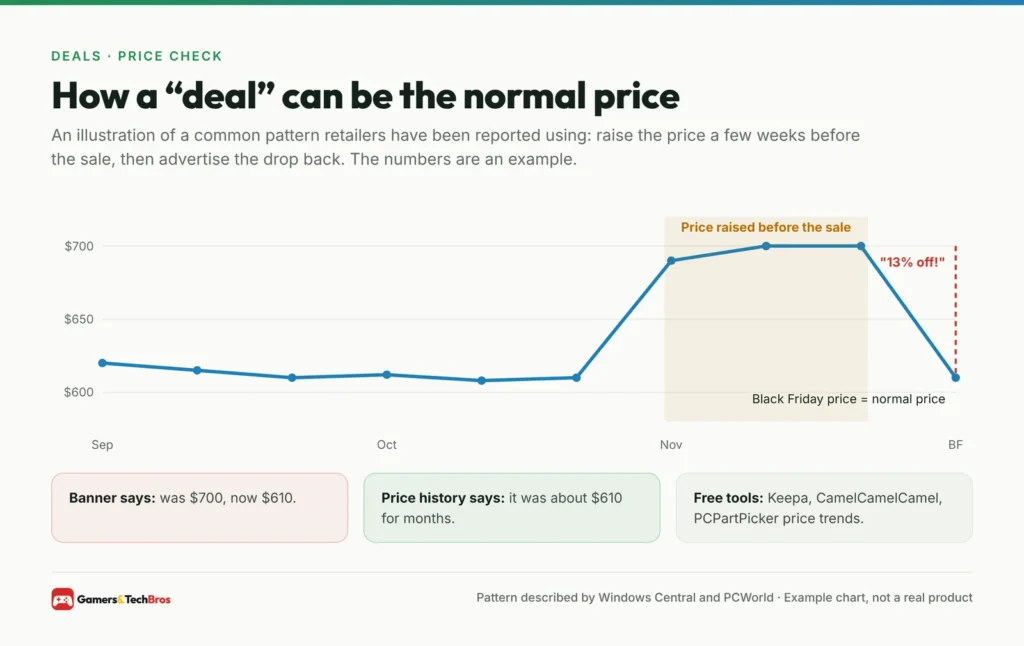
Other stores aren’t magically better. Windows Central points out the old trick of raising prices in October or early November, then dropping them back to normal on Black Friday and calling it a sale. Its example was a PS5 Slim Digital shown as "was $499.99, now $399.99" when the console had launched at $449.99.
What one study of Amazon deals found
In November 2026, Digital Trends reported on a study by the Groundwork Collaborative. The group looked at 351 featured Amazon deals from Black Friday and Cyber Monday in 2024 and 2025, and compared each one with the lowest Keepa price from the previous 30 days.
Almost one in three deals cost the same as, or more than, they had a month earlier. Nearly one in ten were actually more expensive.
Amazon pushed back hard. It called the report "deeply flawed and false", said 350 items is a tiny slice of more than 10 million deals, and said 98 percent of its deal products were at the same or a lower price than in the previous 30 days. Both claims can be partly true at once. Most deals may be fine, and you can still get caught by the ones that aren’t.
The European Union has a rule for this. A store there has to show its own lowest price from the past 30 days when it advertises a discount. Digital Trends notes that the US has no federal rule like it.
2026 is a strange year for PC part prices
This year there’s an extra twist. Memory and storage prices shot up from late 2025 because AI data centers are buying huge amounts of memory chips. PC Gamer’s Black Friday page summed it up in one line: "Prices have been brutal this year, and things don’t seem about to change going into 2027."
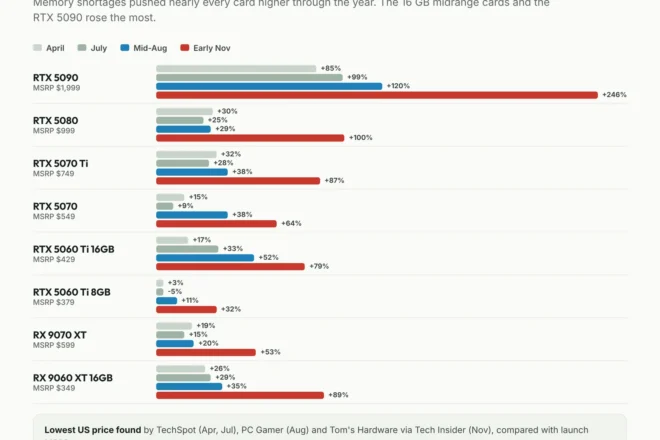
That means a "deal" on a graphics card might still be well above the price it launched at. On November 28, 2026, the cheapest RTX 5070 PC Gamer could find was $900 at Amazon. That card launched with a $549 price tag. Our GPU price guide walks through how that happened.
So for 2026, ask two questions. Is this cheaper than it was last month? And is it a fair price compared with what the part is supposed to cost? A deal can pass the first test and fail the second.
The two-minute check
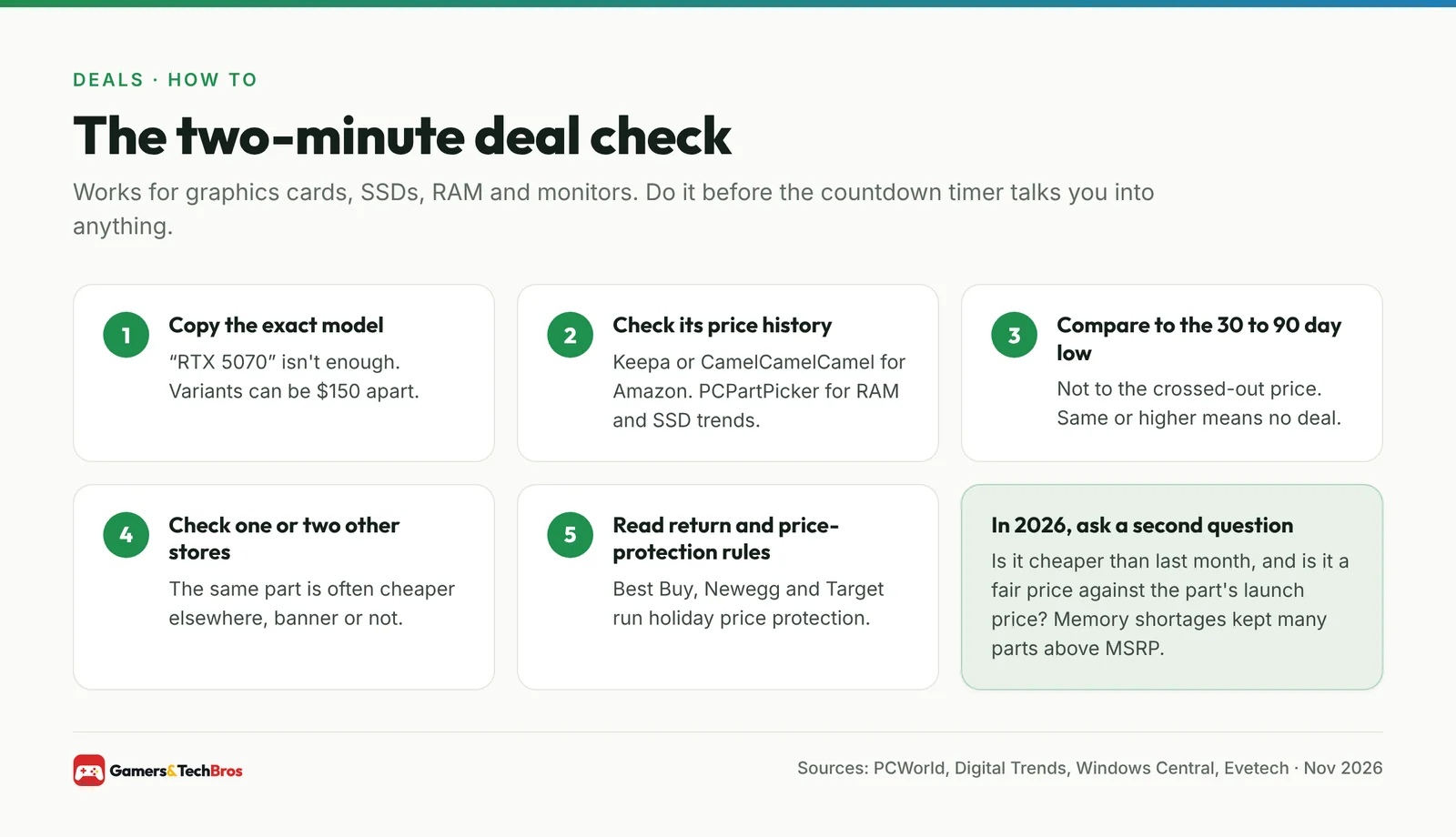
Here’s the routine. It works for graphics cards, SSDs, RAM, monitors, almost anything.
- Copy the exact model name. "RTX 5070" isn’t enough, because a fancy triple-fan version and a basic one can be $150 apart. Use the full name or model code.
- Look up its price history. Keepa and CamelCamelCamel both show free charts for Amazon prices. PCWorld found Keepa matched Amazon’s exact prices a bit better, with CamelCamelCamel close behind. For RAM and SSDs, PCPartPicker’s price trends pages show where the whole market is heading.
- Compare against the low, not the banner. Find the lowest price in the last 30 to 90 days. If today’s price is the same or higher, that 40 percent off sticker is decoration.
- Check one or two other stores. The same card is often cheaper somewhere else, even without a banner.
- Read the return and price-protection rules. Windows Central notes that Best Buy, Newegg and Target all run holiday price-match or price-protection programs with different dates. Amazon’s holiday return window for 2025 ran until January 31, 2026. If the price drops after you buy, these rules can get you the difference back.
South African retailer Evetech gives the simplest version of the same advice on its Black Friday page. Note what the exact model costs a few weeks before the sale, and measure the sale price against that instead of against a percentage on a banner.
A quick gut check for PC parts
Price trackers can’t tell you if a part is right for your PC. Evetech’s list of things to check is a good one: the CPU socket and chipset, the memory generation (DDR4 or DDR5), the graphics card’s length, its power connectors, and whether your CPU cooler fits in the case. A cheap part that doesn’t fit is the most expensive part of all, because you’ll pay to send it back.
Be extra careful with prebuilt PCs. A huge "was" price on a gaming PC is hard to check, because nobody else sells that exact machine. Compare the parts list against what the parts cost on their own, and see our guide to spotting cheap parts in a prebuilt listing.
The calm way to shop
The timer on the deal page is there to make you rush. You don’t have to. Real bargains on PC parts pop up all year, and a part that’s genuinely cheap today will still show up as cheap on a price chart. If the chart says the "deal" is just the normal price wearing a party hat, close the tab and enjoy the money you didn’t spend.
Keep reading
How we researched this guide: we used PCWorld’s investigation of Amazon list prices (April 2026), Digital Trends’ report on the Groundwork Collaborative study and Amazon’s response (November 2026), Windows Central’s Black Friday explainer, PC Gamer’s live Black Friday 2026 deals page and Evetech’s Black Friday 2026 page, all checked on November 28, 2026. We did not buy or track these products ourselves. The RTX 5070 launch price is NVIDIA’s US price at launch.